
Land Rover Defender: Sitting in the correct position

Make sure that you have read and fully understood the relevant warnings before using any of the features in this section.
The seat, head restraint, seat belt, and air bags all contribute to the protection of the user. Correct use of these components gives greater protection. Therefore, always observe the following points:
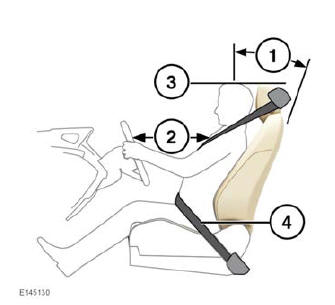
- Sit in an upright position, with the base of the spine as far back as possible. To achieve optimum benefit of the seat belt in the event of an accident, do not recline the seat excessively.
- Do not move the driver's seat too close to the steering wheel. Ideally, a minimum distance of 10 in (254 mm) is recommended between the breastbone and the air bag cover of the steering wheel. Hold the steering wheel in the correct position, with arms slightly bent.
- Adjust the head restraint so that the top of the head restraint is above the centerline of the head.
- Position the seat belt so that it is midway between the neck and shoulder. Fit the strap tightly across the hips, not across the stomach.
Make sure that the driving position is comfortable, enabling full control of the vehicle.
SEAT POSITION MEMORY

Before activating the seat memory, make sure that the area immediately surrounding the seat is clear of obstructions. All occupants should be clear of moving parts to avoid personal injury.
When a preferred driving, door mirror and steering wheel position has been reached, the settings can be stored for future use.
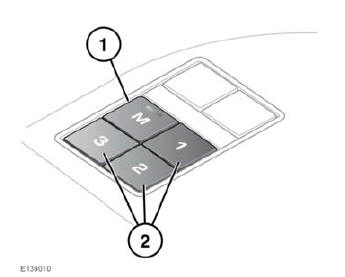
- Press the memory store (M) button to activate the memory function.
- Press one of the preset buttons within 5 seconds to store the current settings.
The message MEMORY (1, 2 or 3) SETTINGS SAVED displays in the instrument panel, and a chime sounds to confirm that the settings have been stored.
Note: A driving position only stores during the 5 second active period.
Note: Any existing settings are overwritten when storing a new memory position.
- Press the relevant preset button to recall a stored position.
Note: The memory function for all passenger seats does not trigger any messages in the instrument panel.
REAR SEAT ACCESS

Make sure that you have read and fully understood the relevant warnings before using any of the features in this section.

Take care not to damage the seatbacks while gaining access to the rear seats.
The front seats tilt and power-slide forward to enable entry and exit of the rear seats.
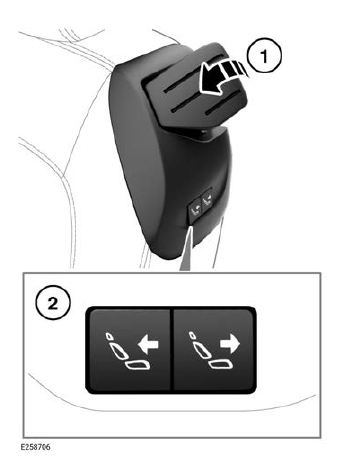
To pivot the seatback forward, lift the locking lever (1).
Depending on vehicle specification, to move the seat forward or backward, use the switch (2) or slide manually.
To return the seatback, manually pivot the seatback until it locks into its previous position.
Note: The previous position can be a memory position or an adjusted position.
If the seat is required to move further rearward and there is still adjustment available, push and hold the switch (2 again).
READ NEXT:
 Rear seat safety
Make sure to read and fully understand
the relevant warnings before using the
features in this section.
Failure to observe warnings and
cautions may result in vehicle damage,
injury, or DEATH in the
Folding and raising the second row seats
Make sure that you have read and fully
understood the relevant warnings
before using any of the features in this
section.
Make sure the locking mechanism is fully
engaged when the seatback is raised
SEE MORE:
Rear towing eye
The screw-in type rear recovery eyes are
designed for on-road recovery only. If
the screw-in type towing eyes are used
for any other purpose, it may result in
vehicle damage and can cause serious
injury or death.
Use extreme caution when moving or
towing the vehicle. Death or serious
injury may oc
Interior Lighting - Description
DESCRIPTION
LOADSPACE LAMPS
NOTES:
Vehicle with 5 doors is shown, vehicle with 3 doors is similar.
Right installation is shown, left installation is similar.
The loadspace includes interior lamps located on the left and right. There
are 2 lamps located in the loadspace side
trims.
The lamps a
