
Land Rover Defender: Full function mode

Make sure the relevant safety warnings have been read and understood before using All Terrain Progress Control (ATPC).
Full function mode builds on the features available in descent control mode, to further enhance the vehicle's ability to gain traction in challenging conditions. The benefits of full function mode include:
- Making a controlled ascent.
- Pulling away from a standstill.
- Driving on unstable and slippery surfaces.
Note: Full function mode is only available if the driver's seat belt is buckled and all doors are closed. The instrument panel displays a warning message if these conditions are not met.
To enter full function mode, first enable ATPC.
The vehicle is now in descent control mode.
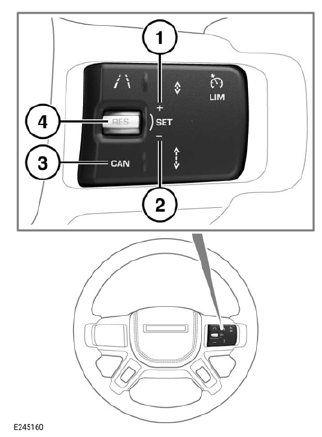
To enter full function mode with the vehicle stationary, move the rocker switch (4) up to the SET+ position (1) with the brake pedal firmly pressed.
To enter full function mode with the vehicle moving, move the rocker switch (4) up to the SET+ position (1).
To adjust the vehicle's speed while full function mode is active:
- Move the switch (4) up to the SET+ position (1) to raise the vehicle's set speed, or:
- Move the switch (4) down to the SET- position (2) to lower the vehicle's set speed.
- Press the CAN button (3) to cancel the speed adjustment, and revert back to descent control mode.
- Press the RES switch (4) to resume the set speed, if the vehicle's speed has been lowered through gentle application of the brake pedal.

The RES switch should only be used if the driver is aware of the set speed and intends to return to it. Pressing the RES switch when not aware of the set speed may lead to a loss of control of the vehicle. Loss of vehicle control could potentially lead to serious injury or death.
Incremental increases or decreases in the set speed vary depending on the vehicle's current set speed, as follows:
- 0.3 mph (0.5 km/h) increments if the vehicle's set speed is between 0 and 3 mph (0 and 5 km/h).
- 0.6 mph (1 km/h) increments if the vehicle's set speed is between 3 and 6 mph (5 and 10 km/h).
- 1 mph (2 km/h) increments if the vehicle's set speed is between 6 and 19 mph (10 and 30 km/h).
The minimum set speed is 2 mph (3 km/h) when the vehicle is in high range. The minimum set speed is 1 mph (1.8 km/h) when the vehicle is in low range.
ATPC reverts back to descent mode if:
- Park (P) or Neutral (N) is selected.
- The Electric Parking Brake (EPB) is applied.
- The brake pedal is firmly pressed.
- The vehicle is brought to a standstill through light application of the brake pedal.
Light, gentle use of the brake pedal lowers the full function mode set speed. When the brake pedal is released, ATPC maintains the speed at which the vehicle was traveling when the brake pedal was released. A slight pulsation may be felt through the brake pedal when ATPC is actively braking.
ALL TERRAIN PROGRESS CONTROL (ATPC) LIMITATIONS
All Terrain Progress Control (ATPC) does not operate if the following systems are enabled:
- Advanced tow assist.
- Wade sensing.
ATPC may also not operate if a system fault is present.
ATPC operation is disabled if the vehicle's speed rises above 50 mph (80 km/h). In this event, the ATPC information lamp extinguishes.
ATPC operation is suspended if:
- The vehicle's speed rises above 19 mph (30 km/h). In this event, the ATPC information lamp flashes. ATPC operation resumes if the vehicle's speed drops below 19 mph (30 km/h).
- The brake or accelerator pedals are used. ATPC operation resumes when the pedals are no longer being used.
ATPC performance is affected:
- If a fault is present in the system. In
some circumstances, ATPC may
operate in descent control mode only.
In this event, the SET rocker switch on the right side steering wheel controls can moved upward to increase the descent control mode set speed.
- If the vehicle's brakes become overheated. ATPC operation is suspended if brake temperatures continue to rise.
The instrument panel displays messages to inform the driver of any performance or system issues.
READ NEXT:
 Driving aids safety
Make sure the following warnings have
been read and fully understood before
using a driving aid system. Failure to use
the driving aids safely could result in an
accident, leading to serious injury or
Lane keep assist (LKA)
Make sure the relevant safety warnings
have been read and understood before
driving the vehicle.
Note: Make sure the LKA system is
disabled when connecting a trailer.
Lane Keep Assist (LKA) monitors
SEE MORE:
Front Center Vent
REMOVAL AND INSTALLATION
REMOVAL
CAUTION:
Do not use metal tools during this operation, removal of the component(s) must
be completed with a plastic
trim tool.
NOTES:
This procedure contains some variation in the illustrations depending
on the vehicle specification, but the
essential informati
Front Lower Control Arm
REMOVAL AND INSTALLATION
SPECIAL TOOL(S)
204-506/1
Remover/Installer, Halfshaft
204-506/3
Remover/Installer, Halfshaft Screw Thread
204-506/5
Retainers, Halfshaft tools
204-598
Hydraulic Cylinder 10t
JLR-204-793A
Ball Joint Splitter
JLR-204-803
Splitter, Upper Arm
JLR-204-838
Ball joint spl
